In 2015 countries adopted a set of goals to end poverty, protect the planet and ensure prosperity for all as part of anew sustainable development agenda and are to be achieved by 2030.
In the UN site there’s a description for each goal with its own facts & figures, targets and links. When reading all of them and thinking about what we are doing today with regards to natural lighting, human health and circadian system, one cannot stop thinking that daylight plays an important role on some of the goals set.
Thinking of how daylight supports the goals established, we realize that the graph above could also look like this:
Some explanation of what the above diagram means, in terms of daylight:
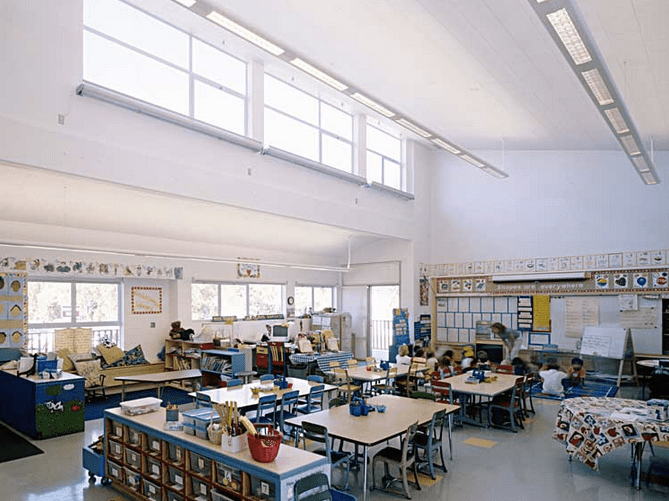
Goal 2 – Zero Hunger – daylight helps produce enough food . There are many places where daylight is abundant which were already exemplary transformed into food production sites.Goal 3 – Good Health and Well Being – daylight regulates the human circadian system, which is our internal clock. It regulates cycles of sleep and awake and connects us to our natural environment. A good part of our health therefore is dependant on daylight and our relation with the environment.Goal 4 – Quality Education – it has already been proved that daylight plays an important role in helping concentration at schools. A well daylit classroom supports the learning process.Goal 6 – Clean Water and Sanitation – it is known that daylight and in special sunlight’s UV has the power of killing bacteria. It is good practice to let things dry and clean under the sun (without necessarily using chemicals for cleaning) as part of sanitation actions. This knowledge or practice is unfortunately being lost, as more people in cities have less access to direct sunlight. This is something we should change in the near future, as cities grow.Goal 7 – Affordable and Clean Energy – useless to say, daylight is an important energy source. It can be harvested, transformed into heat, stored into battery cells for later use, and so on. Technology on daylight/sunlight harvesting will keep developing.Goal 8 – Decent Work and Economic Growth – a good part of creating decent work and decent working conditions is the provision of daylight. A working environment cannot be planned without daylight, as it connects people to the natural environment and circadian rhythm and ultimately makes people more productive (as in the example with schools).Goal 9 – Industry Innovation and Infrastructure – the harvesting of daylight, as light, energy and heat source, will remain an important issue when speaking of sustainability. Innovation in daylight harvesting will still be a big issue on the sustainability agenda.Goal 11 – Sustainable Cities and Communities – urbanization is already a big issue. People moving to cities require more space to live and the cities get denser with buildings very close to one another. This can lead to a very unhealthy environment where daylight does not penetrate the urban tissue. Designing the urban landscape and architecture for the growing city with the extensive use and provision of daylight is already a challenge that needs to be tackled.Goal 12 – Responsible Consumption and Production – daylight plays an important role on the production of many essential items. In this example, daylight is part of the drying process of salt.Goal 13 – Climate Action – as we know that we spend most of our time indoors, it is imperative that the indoor conditions are close to those of the natural environment (air, light and temperature) – that way we avoid being in the so-called “circadian darkness”. Not only we can save energy with the use of daylight indoors, we can also create interesting, dynamic and healthy spaces which connects us to the outside. Combating climate change means a responsible and thoughtful way of using available natural resources, creating resilient economies. Being daylight one resource that will always be there (unless we cover the atmosphere with something), we should make more use of it.Goal 14 – Life Below Water – sunlight and daylight are as big a part of life underwater as they are above water. Animals and plants, oxygen production (and that includes about 30% of the absorption of CO2 from the atmosphere) and a whole food chain (including ours) depend on the availability of natural light.Goal 15 – Life on Land – following all the above mentioned, there’s no need to say daylight is an important part of the earth’s ecosystem and without it, as it is with water, there’s no life. The misuse of forests, the desertification process and biodiversity loss are all actual threats to life on land. Unless we develop gills and learn how to breath underwater, we should change the way we are treating our land and living environment.
As obvious as it may sound, as often as we may be repeating, again, daylight is an integral part of human life and cannot be taken for granted. Now it is the moment of changing the way we think, design and act in order to save the world for future generations.




 The Lighting Tips
Leave a comment