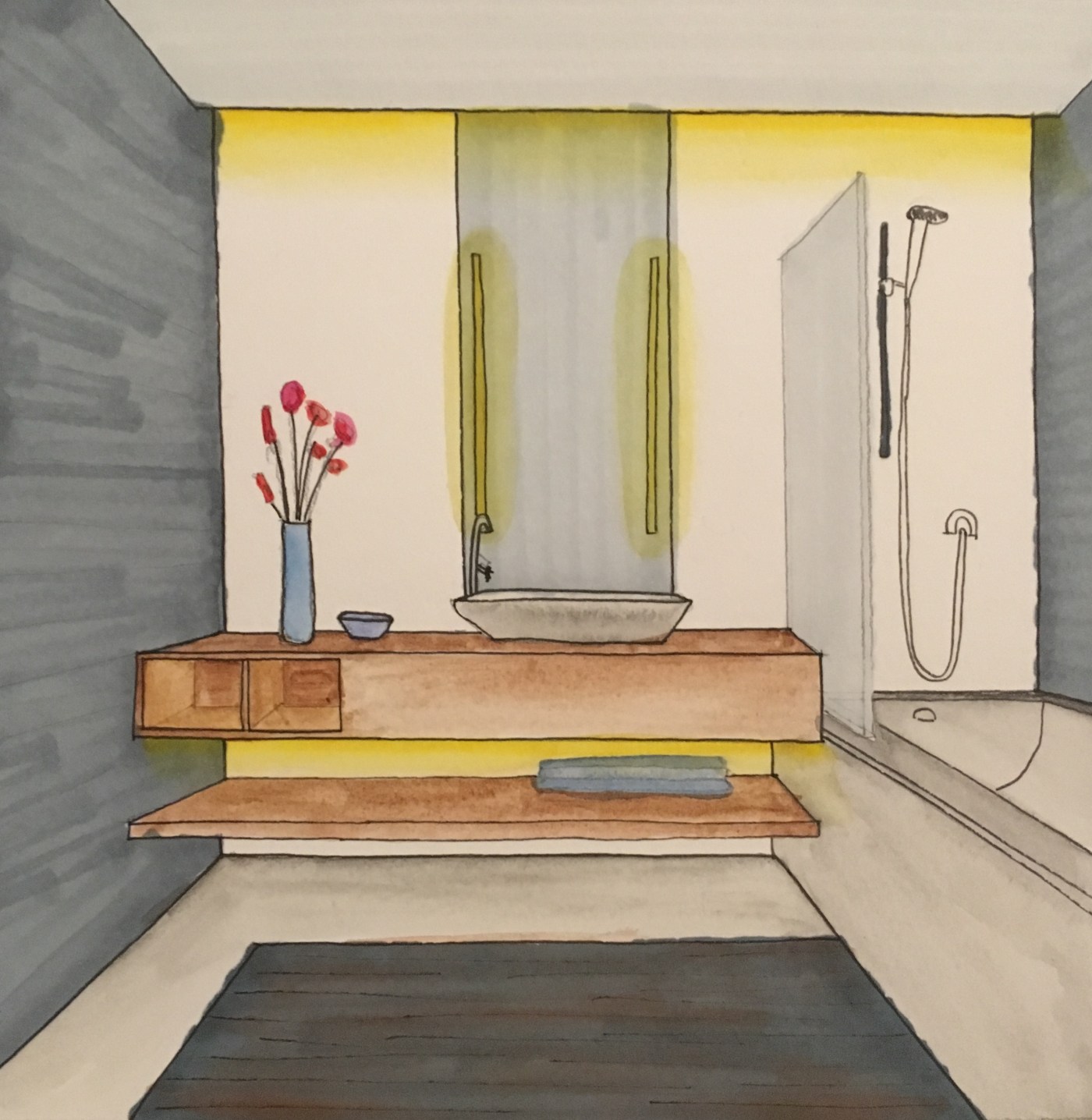
The lighting for the bathroom space should consider the materiality and colour palette of the space. Here it is also important to think about the appropriate equipment (key word: moisture) to be used, colour rendition and light colour.
In the bathroom it’s all about atmosphere. As opposed to the lighting in the kitchen, the bathroom requires mainly a more diffuse, soft lighting. The working surfaces here are not as important and vertical soft lighting is a key issue. The lighting layers in the bathroom space can be as follows:
- Concealed lighting behind the mirror will give an overall soft lighting atmosphere. This lighting can be both indirect – i.e. light to the ceiling – and/or direct – i.e. light to the wash basin. Although this soft lighting is appropriate to generally light the bathroom, it will be too dim to be used as lighting for makeup or shaving. A dedicated lighting layer should be provided for these functions, described below.

- For the functional lighting for make up and shaving, there are many ways to incorporate lighting. Some people like to use a dedicated mirror with integrated lighting. This mirror can be installed on a side wall (provision for electric power should be considered) and usually has an extension arm for adjustability. Alternatively, there are large-sized mirrors which contain direct lighting (as in the main image above). This option can turn out practical if there aren’t walls left available for an extra mirror.
- In addition to the lighting concealed within the mirror build-up, cove lighting along an important wall can also provide enough diffuse light for the space. In the drawing above, the back wall “crosses” the shower and bath tube, lighting both softly.
- Minimum lighting or low-level lighting is provided below the sink (in this case without cabinet). This lighting is quite soft and dim and should be put in a separate lighting circuit, making it useful for relaxing bathtub sessions or a night visit to the toilet.
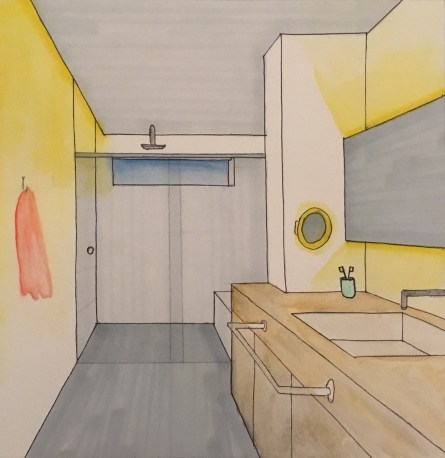
As mentioned above the lighting equipment should have special moisture protection, so that the equipment doesn’t get wet inside. That is something very important to look for when choosing the luminaires for installation. IP x4 should be chosen (this means that the equipment is protected against splashing water), especially in the areas close to the wash basin or the shower.
Colour rendition of a light source is the property of this light source to accurately render colours. The most used method is the CRI (colour rendering index) and its scale goes up to 100, being 100 the best value. When choosing equipment for your installation, make sure you double-check this information. We recommend that the lighting equipment to be used has a CRI above 80.
Regarding light colour temperature – that’s the colour appearance of a light source and is described in Kelvin. The higher the number (e.g 5000K) the cooler the light colour. What is usually used in residential spaces are light sources with light colour below 3500K-4000K. Depending on the materiality and colours of your space you might want to use a warmer or more neutral light colour. We recommend that materials with warm colour tones be enhanced by warmer light colour (2500K-3000K) and, on the other hand, materials with blueish/greenish colours be enhanced by more neutral light colours (3000K-4000K).
Although the aim is to create a comforting atmosphere, the lighting should be designed in such way as to provide enough light for cleaning purposes. It could be an additional lighting circuit which is included in the design, or even working with dimming levels, being the highest level used for cleaning. If you use dimming, you can create another layer of adjustability in the design. The difference in implementation costs should be weighted against the aim of the design and budget.
Like to share your designs with us? We are happy to give you advice. Get in touch!
See you in the next post.
#thelightingtips © all rights reserved
 The Lighting Tips
Leave a comment