How is it that we see colours and what has light got to do with that?
First of all, all we see depend on light. If there was no light, we wouldn’t see anything. Remember the beautiful quote from Le Corbusier “Architecture is a learned game, correct and magnificent, of forms assembled in light.” But how is it that light influences what and how we see?

First of all, there’s some physics to it. Visible light has wavelengths in the range of 400 nm (violet) to 700 nm (red). Below 400 nm are ultra violet waves (UV) and above 700 nm are infrared waves (IR), these are not visible to the human eye. Remember that the sunlight is composed of many colours in the visible spectrum (the rainbow is represented with 7 main colours, but that is just a simplification as there are many more!) and that objects absorb and reflect light? The way we see colours is actually quite simple: the light has a certain spectrum, which contains more or less colours. For instance, when we say an object is red, we are actually recognising that all the colours of the visible spectrum reaching this object are being absorbed and only the one coming to our eyes is actually being reflected – red. If an object is white, it reflects all colours. On the other hand, if it is black, it absorbs all colours.
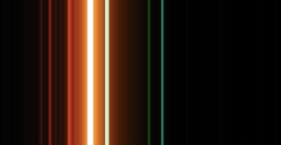
An interesting example is the reflection and absorption of light from a narrow spectrum light source. Have you ever been to a place where at night the street luminaires give a yellowish kind of light, with about 1800 Kelvin? That could have been low pressure sodium – a type of lamp which was extensively used in the past in street and facade lighting for its efficiency. The low-pressure sodium lamp has a very high peak in the green-yellow part of the visible spectrum (around 590 nm) which makes it very difficult to distinguish other colours. In that case, we see colours distorted, as they cannot absorb and reflect wavelengths not contained in the light. See the example below.

Therefore, light does play an important role on the way we perceive objects, rooms, architecture and the world around us. Depending on the quality of the light source, we can truly see the colours, or not.
Light sources have evolved a lot in the last decades, but even in the age of LEDs not all electric light we see is of best quality. This also has something to do with costs and so, cheaper LEDs with a colour rendering index (CRI) of less than 80 are being applied in exchange of less energy-efficient light sources. CRI is ability of a light source to reveal the colours of various objects faithfully in comparison with an ideal or natural light source (100 is maximum = daylight). So, we will still be seeing objects and architecture not in their entire beauty. Interestingly, the low pressure sodium lamp shown above has a CRI of -44! Best practice says we should apply light sources with a CRI of more than 80, as colour distortion is minimal. Even then, there are certain applications which require the best CRI we can get. Retail spaces, hospitals, some types of offices dealing with colours are some of the spaces where a very high CRI is definitely required. I would suggest that the best CRI available should be used everywhere if we would like to have a nice and beautifully and properly lit environment. As mentioned above, cost can be an issue, so it is good to understand where we are applying which type of light source.
Now, here are some examples of different light sources and their spectra:


The light source with full spectrum shown at the top is daylight, the one on the left is a high pressure sodium lamp (some peaks on certain colours and lack of others, but much better than low pressure sodium) and the one on the right is a red neon tube (due to the colour of the lamp, its spectrum is more on the reds and lack most of the other colours).
The topic of light and colour is much wider than we have approached in this post. Therefore, expect to see other posts on the subject where we’ll be talking about colour rendering, light colour mixing and other aspects of light and colour!
See you in the next post
#thelightingtips
 The Lighting Tips
Leave a comment