
Is there a space in the home with so many activities as the dining room? That’s the place where most home meetings happen, be it a family or business meeting or even quick talk over tea, it’s the home work space or where the children express their artistic skills. With so much happening in this space, it is more than desirable that it receives good lighting.
The dining space should create a cosy, relaxing and inviting atmosphere. In order to achieve this, careful thought about the materials and colours of the space and furniture should be done, together with the lighting scheme.
Sometimes the dining room shares another space in the home. It is connected to the kitchen or the living room. And sometimes it is just a stand-alone room. However the space you have is, the following tips or rules will apply. As we have described in other “tip posts” (e.g. bedroom lighting) the lighting of the dining room is also composed of layers. These are, similar to the bedroom lighting tips, composed of:
- Background lighting – here we are showing how important the surrounding walls are to help define the space;
- Highlight of surrounding objects or art pieces;
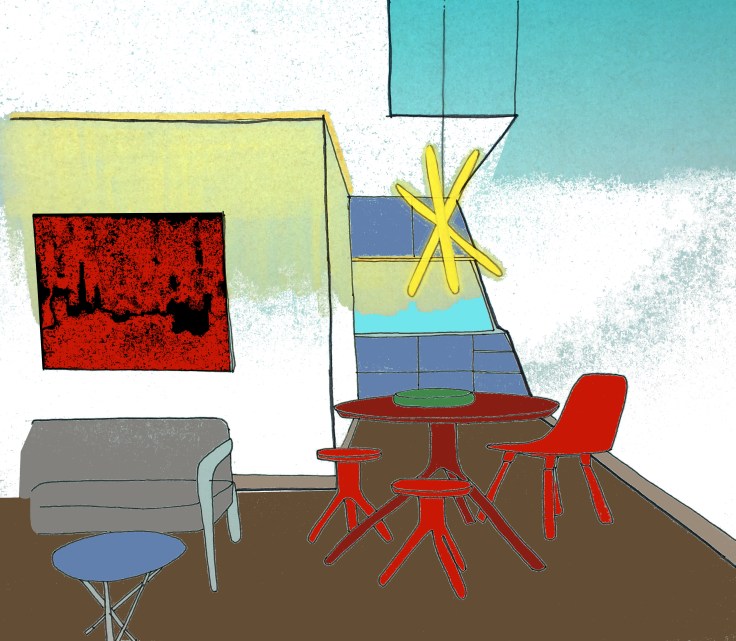
- Decorative lighting – for the dining room, the main object to draw attention will be the pendant above the dining table.


In most homes, the dining room is connected to another space. It can be part of the living space or the kitchen, as mentioned, but it can also be connected to an outside space, like a terrace for example. If this is your case, always allow for view to the outside when defining the position of the table. A view to the outside can be a relaxing feature of the dining space.

The layer background lighting mentioned above refers to the surrounding vertical elements that define the space. It can be a wall, but it can also be a series of columns (as in the main image above), or even a divider panel which is functioning as space defining element. A nice way to bring light to this element is to create a cove, graze light or line of spotlights to accentuate the verticality and therefore underline the perimeter of the space. This light will also function as general light to the space.
Should there be any special element worth highlighting, special accent lighting can be included. Depending on the object type and size (painting on wall, sculpture, photo frames, etc) the lighting can be tailored to suit the object. A very flexible way to achieve that highlight is to include a number of adjustable spotlights (recessed into the ceiling or not, or even mounted on a lighting track). That way, the objects receive more than one light source enhancing their features.
And the main decorative element in the dining room will be, of course, the pendant above the table. Be carefull if you have a glass table. The glass surface will probably reflect all the light coming from the pendant above and this can be quite annoying. If this is the case. That way, you will probably get the ceiling reflected, but that will be much more comfortable than concentrated light.
Choosing the right pendant can be a tricky task. Many factors will need to be considered before you get your luminaire in place. Here are some notes:
- Light distribution of the pendant will be important. Direct light only or direct and indirect light, or diffuse or only indirect? The way the pendant distributes light in the space will make a huge difference in how the space is perceived. A direct pendant will concentrate light on the table surface, leaving the ceiling dark. A direct/indirect or diffuse light emitting pendant, will instead, include the ceiling in the scene, making the space feeling wider or taller. The rule of thumb is simple – if the space you have has a high ceiling, then choose a direct only light emitting pendant to create a cosy atmosphere. If the space is not as tall, and you would like to have more sense of height, choose a diffuse or direct/indirect light emitting pendant.
- Who is seating around the table and most importantly: how tall are they? This information will help you define the pendant height in relation to the table. Usually the distance from table to pendant lies somewhere between 70-85cm. But that will depend on 2 factors: the people and the pendant type. Pendants that emit only direct light tend to be very bright at the bottom (high luminance and possibly a glare source). Therefore, it would be best to find a height that does not create glare the people around the table while seating. Also, avoid installing the pendant too low, otherwise it will become a disturbing element, blocking the view. The diffuse light or direct/indirect pendant will probably be less disturbing with regards to glare, but still require some thought. With that in mind, before you fix the mounting height, make some tests with someone else seating, so you have feedback on which height is the most appropriate for the pendant in the space.
Another important lighting tip is controls and dimming. Ideally each lighting layer has a different control or light circuit. That way, you can make the most of the space creating different scenes. If you can get a dimmer for your centre piece, you will be able to regulate the amount of light in the space and on the table and create different scenes for the several functions, as described above.
Daylight should always be welcomed in every space at home. The dining room is not an exception. It will bring the view out if you have windows and plenty of quality daylight if you have a skylight. Enjoy this daylight, as the more we have of it, the better we feel as humans.
We hope these tips have helped you create a cosy and relaxing space at home. Have any questions? Feel free to contact us!
See you in the next post.
#thelightingtips
 The Lighting Tips
Leave a comment