
Hello everyone!
So, I’ve been giving some thought about the whole Human-Centric-Lighting (HCL) buzz which is happening in the lighting industry recently. Maybe it’s my misinterpretation of the wording, but Human-Centric to me means to put humans and their needs in the centre – of whatever we do… Following this thought, HCL would mean to put humans and their needs in the centre of lighting planing or design. Having said that, what are the needs of humans with regards to lighting?
- Is it 500 lux on the working plane, which is given by norms?
- Is it vertical illuminance maybe – which is coming up with the WELL certification?
- Is it a full spectrum light source, which might be comparable to the spectrum of daylight/sunlight, which some LEDs are almost getting to?
- Is it the ability to have an installation which changes light colour and partially mimics the natural daylight changes in light colour, which apparently is what the industry is trying to sell as HCL?
- A better colour rendering of light sources, which also almost but don’t quite get there when compared to daylight (even if we change the metrics to LEDs)?
- Is it to be energy-efficient and be low-cost?
For me, the answer would be all of the above AND none of the above.
Human needs with regards to light is intrinsically based on the qualities – and quantities – of daylight. Electric light can only mimic daylight to a certain extent, but not provide the full package! For that, we’d need electric lighting to:
- be much higher than 500 lux – all the time. Say maybe 3.000 lux – 5.000 lux or even more…
- vertical illuminance very high and in all directions.
- real full spectrum – actually including UV and IR (not pledging for people to get sun burnt here, but without UV we hardly produce vitamin D).
- constant change in light colour as to mimic sunlight, skylight, clouds, building orientation, time of the day, time of year, etc, etc.
- a great colour rendering – one to which our vision equipment (the eyes, the cells in the eyes and the interpreting system – the brain) is made for.
- be free of charge – to get and to maintain. (Daylight is a free commodity! You don’t need to pay a penny extra to have all of the great qualities and amount of the items listed above!)
So, in my humble opinion (and I am an architect and electrical lighting designer as well), electric light should only supply light when and where daylight is not able to reach – not in all means replace it. This means that our buildings should also be designed to HCL!
As we spend most of the daytime inside buildings, be it in the nursery, in schools, in universities, in offices or even at home, and miss all the quality daylight available outside. And the consequences are becoming more evident as people begin to suffer of different disorders which to a large extent can be related to the lack of daylight.
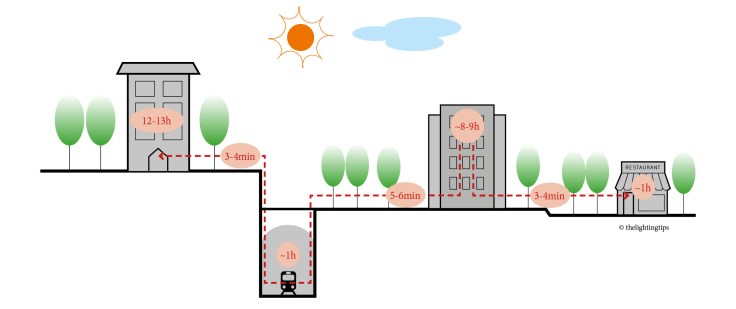
I have actually measured how much “daylight” I get during the day – summer or winter. I have a 3-4 minutes walk from my door to the underground station, then another 5-6 minutes walk from the underground station to the office. Then during lunch I walk 3-4 minutes to the restaurant and another 3-4 minutes back. Coming home at the end of the day is the same during the summer months, but without daylight in winter. That would mean a total of around 20 minutes full daylight exposure to me every day (in full clothing and except weekends), winter days even less. Then I sit about 8 hours in an office at the top floor of an old construction which was poorly redesigned (in daylight terms) to fit modern life. We have windows facing West, which means that nice diffuse daylight comes in in the mornings – not a lot though, as we still have the electric lights on in some areas – but just after lunch my colleagues need to close the blinds as sunlight is just too strong for them to work on their screens. And so, I’m again deprived of my daily dose of daylight. So instead and to compensate this lack, I take daily dose of vitamin D!
Architecture is the main “shaper” of daylight falling into the interior spaces, so it should be designed to allow as much of daylight inside buildings as possible, BECAUSE THIS IS WHAT PEOPLE NEED, and that would truly be HCL! Daylight designers are able to assist Architects get it right in these days, when architecture has become technologically more complicated than a century ago. It’s not only about changing the light transmission of the glazing or fine tune the U-value… It is about creating a condition where abundant daylight is pouring inside buildings – not to an unmanned atrium space but to where people are!
You may argue, of course, that we can build fully glazed buildings only – independent of what the “aesthetic reason” for that may be. But we actually have done that (a lot) in the past and realised that this is either HCL oriented nor is it sustainable enough – at least it’s not really working for most parts of the planet.
Good daylight design which is HCL does not mean fully glazed facades, it means well thought, designed and built buildings:
- Each facade orientation should have a special/different treatment and be in accordance to climate – I’m not talking about choosing different glazing properties, I’m talking about architectural approaches to tackle a strong and moving light source outdoors;
- Openings should be as large as possible, but cleverly positioned, taking care that sunlight might need to be restrained from entering the building, otherwise we get to build large scale saunas or glasshouses;
- Design the openings to get as much diffuse skylight and possibly also some direct light from the sun at certain times of the day;
- Use more skylights to bring a lot of daylight to the interiors. Skylights to allow about 3 times more daylight in when compared to the same size vertical opening;
- Room heights should be higher that what we are planning today – what is the current market practice? 2,5m with 3m being floor to floor height? Maybe slightly higher ceiling heights, specially in the lower floors would mean more sky view and therefore more skylight would enter the space;
- The classical “same floor” approach should be re-thought. It’s great that we can rationalise construction and praise repetition, but the result is not always Human-Centric. Different floor plans can allow daylight to penetrate to lower floors, while creating interesting spaces.
It is not only in the hands of the Architects alone to design a well daylit building. Architects have other Engineers at hand to help them realise a successful building, being some of those the daylight designers, the building physics and the facade engineers to name a few. As in many things of life, achieving truly and sustainable HCL or rather Human-Centric-Architecture or Human-Centric-Design is a team effort – independent of what the industry is trying to sell you. And if a gimmick of automatic colour changing lighting effect makes you think that this is what will entice people to make them work more, please read this article from the beginning.
I leave now but would be delighted to hear about your experiences with daylight and the HCL topic. I hope I have left some good reasons to plan daylight in buildings from day one.
See you in the next post.
#thelightingtips
 The Lighting Tips
Leave a comment